We now turn to the second chapter regarding Formal Morality: Intersubjective Validity. If you have not yet seen the summary for the first chapter, go here. Let me first make an important clarification. Some philosophers use the term morality and ethics interchangeably to mean in general a good act. Dussel does not. For Dussel ethics is purely the material dimension (“the content of ethics”),1 while morality is the formal dimension (“procedural, communitarian intersubjective”).2 Think of it as ethics having the content while morality having the form. Ethics tells us how to act in terms of the content of the acts, while morality tells us how to act in terms of mode of acting. As mentioned in the previous post, when an act complies with the material-universal principle of ethics it has practical truth. In contrast, when an act complies with the moral dimension it has validity; we will see what this means for Dussel. Ethics is thus solely concerned with the unfolding of life, i.e., with the production, reproduction, and development of the life of all. Let us now turn to this second chapter which focuses on Formal Morality.
Dussel starts: “human life in its rational dimension, knows that life, as being in a community of living beings, is ensured through the participation of all. Linguistic communication is an essential dimension of human life, and rational argumentation is a new ‘cunning’ of life”.3 He continues: “[i]f the aspect of content (or material) of ethics […] grounds the material principle of ethics, the the formal aspect of morality […] grounds the procedural principle”.4 In other words, the material principle of the unfolding of life dictates the content of a good act, while the formal aspect, which will be discussed throughout this post, guides the procedure of application. For example, it is not the same to say a good soccer player scores goals, than to say the procedure aimed towards scoring goals; such is the difference between the ethical and the moral for Dussel.
The history of procedural ethics is rich and has been the origin of multiple important debates in philosophy. Dussel considers three main procedural ethics: (1) Kant’s deontology, (2) John Rawls’ Theory of Justice, and (3) the discursive ethics of (3a) Apel and (3b) Habermas. To reduce the extent of this blog entry, I will not go in depth into each of these perspectives because they are rich in content and I will not be able to do them justice here (no pun intended to Rawls), hence I will restrict myself to present Dussel’s insightful critiques. You will be able, however, to find some resources on each of the views critiqued by Dussel below in case someone is eager to know them.* If, however, you are already familiar with these procedural theories you may find the exposition reductive. This may be so but, again, the point of focus here is not these theories but Dussel’s response to them and his subsumption of them. That is to say, we are not concerned with their arguments but with how Dussel interprets them and absorbs them into his own philosophy. Let us carry on.
Kant argued for a categorical imperative. Such an imperative states that one must “[a]ct only according to that maxim whereby you can at the same time will that it should become a universal law”. Hence, Kant argued for a way of making a universal judgement. In such a view, we can only act if we believe that if such an act were to be carried out everywhere it would be fine. For example, one cannot steal because if all people stealed at all times chaos would ensue. However, according to Dussel’s reading, Kant “was never able to integrate the material, emotive aspect of ethics […] Kant never had within his reach a notion that would allow him to articulate the rational moment with human sentiments, with the ontological and historical-cultural level”.5 That is, Kant’s proceduralist morality, resumed in the categorical imperative, does not have any explicit content within. To some extent it presupposes some content in that a ‘rational’ person would deem certain actions as universal maxims, but Kant does not express a criterion for specifying this. Ergo, it is up to the individual to judge whether an act is universal. What if I truly believe that a certain norm can be universal even if others do not agree? Kant’s categorical imperative merely stipulates the rules to follow to arrive at a norm but not the aim of such norm. Think of morality as the rules in a game. Games need more than rules, the rules have an orientation and a purpose. If we are playing monopoly it is not enough to say “you should not steal money from the board”. There must be an underlying content justification like “stealing from the board makes the game unjust”. Interestingly, Dussel states that Kant “had explicit consciousness of the need for a formal-material connection”,6 but he was not able to derive the material because of a reductive conception of what the material is. As a consequence, from Kant we inherited, Dussel says, an “inverted architecture”7 which will be carried out by both Rawls and the discourse ethics of Apel and Habermas. Such inverted architecture is thinking that procedure will result in content, when in reality it is content that guides the procedure. From Kant (1785), Dussel makes a jump in time all the way to Rawls (1971).
Rawls’ moral theory argues for two principles which are thought to be derived from the original position. The original position of Rawls is a thought experiment in which one must envision all humans getting together to work the principles of a society, with the important proviso that no one knows where or how they will end up in the society they choose to build; they do not know if they will be the privileged, or the victims. The participants are placed behind a veil of ignorance and thus do not know their gender, race, intelligence, or other personal characteristics. The only thing they would have is their rationality and self-interest. From this several critiques can be made including the possibility of having rationality detached from personal characteristics, or self-interest without knowledge of the self. Alas, from such thought experiment, Rawls believes that two principles will be derived:
- Each person is to have the most extensive basic liberty compatible with a similar liberty for all.
- Social and economic inequalities are to be arranged so that they are both (a) reasonably expected to be to everyone’s advantage, and (b) attached to positions and offices open to all.
The first principle establishes that all have the same basic liberty, as in rights, as others, so long as this does not interfere with the rights of others. For example, all would have a certain degree of freedom of speech so long as having freedom of speech does not interfere with another person’s freedom of speech. The second principle establishes a way to deal with inequalities, concretely social and economic inequalities. Inequalities, firstly, can only exist so long as the inequality is to everyone’s advantage. For example, a society in which there is economic inequality can only justify their inequality if such inequality is better for everyone, including the worst off. Moreover, such inequalities must be the result of ‘positions and offices’ that are accessible to all. That way the inequalities may be thought to be dynamic. That is, inequalities are not rigid but all have the opportunity to be on the privileged side.
Dussel is very critical of Rawls’s theory, perhaps because, as Sandel notes in The Tyranny of Merit, the principles are not principles to ensure equality, but to justify inequality [cite Tyranny of Merit]. Furthermore, as Dussel notes, “[i]f in the first principle we speak of ‘equality’, in the second we admit a priori (since it would be a result of the ‘original position’) ‘inequalities’”.8 Why, Dussel asks, if there is no inequality in the first principle, would there be inequalities in the second? It must be because such inequalities are contained in the first. If inequalities exist in the social and economic dimensions it is because some rights allow for some people to become ‘better off’. Why, furthermore, are “economic and social inequalities” admitted?9 To Rawls a set of liberties cannot be unequal, and yet economic and social inequalities are. One may think that a group of people in the original position would think that social and economic inequality is not acceptable. It thus seems that there is much Rawls is presupposing, like people finding rights more important than social and economic equality. “Rawls has a special blindness when attempting to comprehend that it is one thing to have the ‘fortune’ to be born in a family […] but another thing that there are historical and social structures (not natural)” like the capitalist system which creates inequality.10 Rawls himself finds the inequalities undeserved (see Rawls 1971 sec. 17), but “[w]hy does Rawls not state explicitly that they are unjust?”.11 The inequality is produced by material content that Rawls ignores because he wants a ‘pure’ formal morality ––much like Kant. Hence, Rawls falls into what Dussel calls the fallacy of formalism: “lack[ing] critical criteria and principles with respect to the content (material) that it presupposes and to which one in fact has recourse, but without consciousness”.12 What Rawls presupposes is that inequality, even when the worst are better off, while undeserving, is not unjust. He however, does not make explicit such supposition and ends up making it a major aspect of his principles. What Dussel then absorbs from Rawls critique is the wariness of presupposing contingent aspects into moral-procedural universality. That is, multiple phenomena are only accidental or situated within a specific context. For example, the fact that we dress as we dress today is not universal or necessary. The way we dress today is the product of history with its multiple variables. Thinking of the way we dress today as universal would be a mistake and, even more so, abstracting from these rules of action would result in a normative mistake. Or, as Dussel puts it, “[f]ormalism cannot then present […], and least of all, criticize or put materially in question, the capitalist economic system that it already presupposes a priori […], because it inadvertently serves as justification at the moral-formal level” .13
Moving on to discourse ethics as espoused by K.O. Apel and Habermas, one can see how, out of the perspectives analyzed in the chapter, it is the most welcomed or embraced theory while still drawing several critiques. Before going to the critiques, let me give a quick overview of what discourse ethics entails. Perhaps the most relevant feature of discourse ethics is the argument of the “a priori of the community of communication and the grounding of ethics”.14 In other words, the community of communication, which is any human community, is “the transcendental and ethical presupposition of all language, argumentation, and possible discourse” p.121. That is, the existence of language presupposes that rational argumentation is possible, and as such, agreement can be reached. Moreover, it is because we can communicate that speaking of a good act is possible; we can give reasons why X is good, and why Y is wrong. If this is so, say the theoreticians of discourse ethics, then it is possible to argue for a moral principle. Namely, if we can talk to each other and reach a common understanding, we must also be able to do so regarding what a good action is. Put simply, if we can talk and agree that the sky is blue, we can talk and agree that a certain norm is valid. However, in order to do so certain rules are necessary.
What rules would be necessary in order for a moral principle to be valid if it derived from argumentation? Habermas argues for a discourse principle (D): “The only norms which are valid are those which have been accepted by all those accepted as virtual participants in a practical discourse”.15 Such principle “is mediated by the procedure U, which assumes in practical discourses the role of a rule of argumentation”.16 Principle U establishes that: “the foreseeable consequences and results of the general following of valid norms for the fulfillment of the interests of each one ought to be freely accepted by all”.17 Specifically, the principles together entail that a moral rule will be valid if it is the process of argumentation carried out by all, and that the imagined consequences of following such rule are to the best interests of all, which they realize without coercion. One can see clearly a similarity to Rawls’ principles with some important and relevant distinctions. However, here we are not concerned with an imaginary original position but with actual conversation within the lifeworld [lebenswelt] ––how Habermas refers to the general background a person has, e.g. his community and everything concerned with it.
In addition, according to Habermas, the “[n]eeds and wants” assessed in discussion “are interpreted in the light of cultural values” through evaluative statements.18 Similarly to the critique of Rawls, both Apel and Habermas try to avoid a material dimension but nonetheless assume one: that needs are interpreted through cultural values. As such, they understand that each culture or subculture has a unique perspective of needs and, as such, that needs are not universal. You can imagine how Dussel would argue against this: the unfolding is universal and cultural values are only a way of mediating the unfolding of life. Dussel further problematizes this with a very helpful figure which I will reproduce through deconstruction. Recall that Habermas argues that necessities are seen in light of cultural values. Cultural values are expressed in evaluative statements. Thus one can envision Habermas’ Moral Theory as follows:
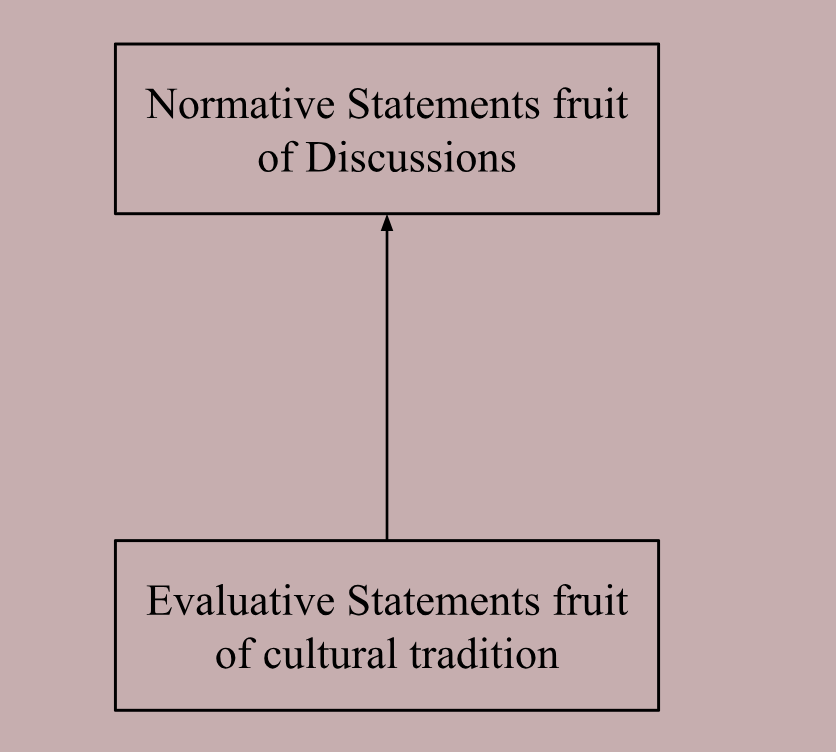
According to Habermas, we have first an evaluative statement that is passed through culture. For example: “bullfighting, as a tradition in Mexico, is permissible”. Such an evaluative statement is then judged through discussion and is transformed into a normative statement with validity if everyone affected participated and if they all agree on the consequences.** However, the discussion could also result in people doubting or questioning the evaluative statement of tradition resulting in “it is immoral to bullfight”. As Dussel states, “[t]he only relation that Habermas can analyze is the passage from the dogmatic level of the value judgement […] to the normative statement” p.136. Is it possible to have other forms of moral critique? What other relations does Dussel propose? Dussel proposes 4 complimentary relations. Dussel’s Moral Theory:
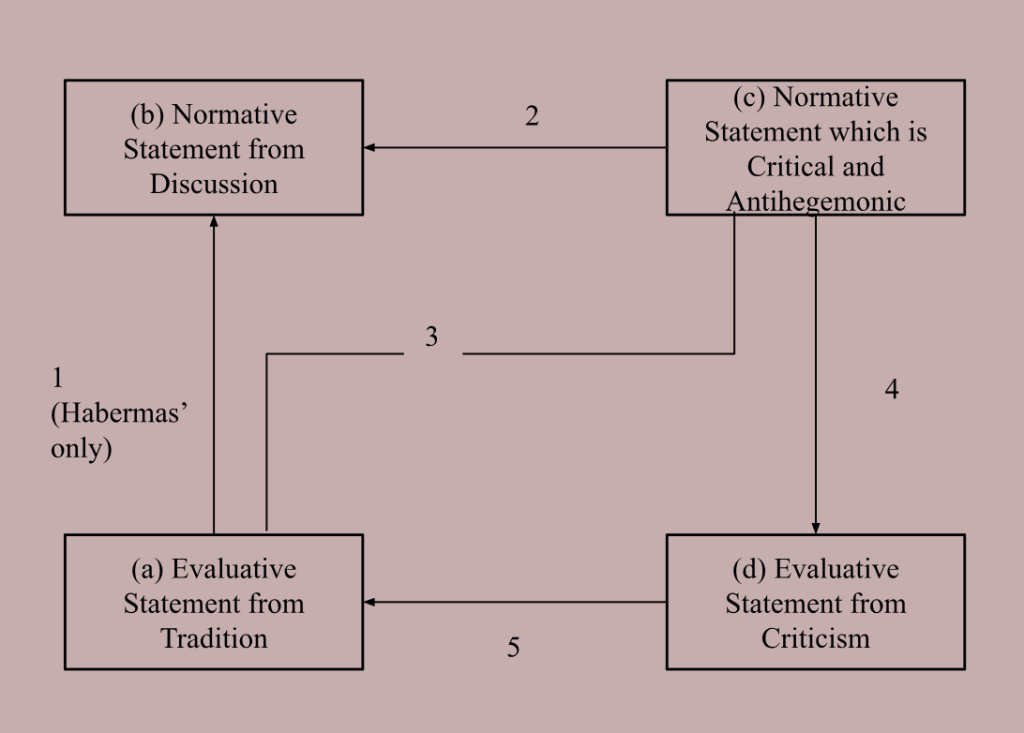
The first relationship we have already discussed, it is the passage of the traditional evaluative statement to a normative statement through rationalization. The second passage entails that a normative statement that is material (recall the previous post on the material) can judge a normative statement derived from discussion. That is, it is a passage from the box labelled c to the box labelled b. For example, if all agree for the destruction of the environment and, for some reason, all agree with the consequences, for Habermas this would be deemed a valid normative statement and would have no way of countering it if all agreed. However, Dussel’s arrow #2 does establish a way in which a critique to such a valid discussion agreement could be challenged. For example a factual claim that the destruction of the environment would result in the impossibility of unfolding life and that we ought to allow for the unfolding of life.
Arrow #3 is similar in that, from a factual material-normative statement (c), one can judge evaluative statements from tradition (a). For example, a culture has a belief that human sacrifice of X number of people per year will help their crops. While Habermas can only assess the norm through discussion, arrow #3 may establish beforehand that human sacrifice is not correct.
Arrow #4 may be better understood after understanding arrow #5. Arrow #5 establishes that, within a community, a group of victims (those whose life cannot unfold), can criticize the hegemonic culture (a) as invalid through their own culture (d). For example, in racist societies, the white tradition is deemed to be correct. Those who are not white having their own culture can give an evaluative statement like “our way of being is valuable”.
Arrow #4 is similar to Arrow #3 in that it criticizes a culture, but this time the culture of victims (d). Victims can have evaluative statements that are incorrect. For example, in a patriarchal society both men and women are victims (in different ways and degrees). Because of tradition the male culture derives a statement which says “men ought not to show feelings”. The material statement would reply: “The statement you made stems from the fact that you are a victim. The patriarchy enshrines an idea of men as without feelings, but this is incorrect”.
As seen, Apel and Habermas neglect some materiality but do not reject it per se. Rather, Apel and Habermas establish that materiality will be developed from free argumentation. In other words, the content of morality will be the result of the process. But to do so one must know their interests which is, in and of itself, already a material condition ––even if Habermas and Apel argue it is cultural. Hence, they both fall into the proceduralist fallacy. Moreover, several critiques of discourse ethics focus on its impossibility (or difficulty) regarding argumentation free from power or coercion. Given power structures in real life (in the lebenswelt), it is not possible to have such discourse because some will not be free or have the capacity to exert power over others, thus coercing them (see Young’s Justice and the Politics of Difference, Benhabib’s Situating the Self). As Dussel states in a footnote, the mode or way of speaking already reveals some kind of power. Otherwise stated, discourse ethics “presupposes an empirically impossible perfect symmetry among the participants”.19 We will see in chapter 5 how Dussel tries to overcome the empirical impossibility of having symmetry between participants. In addition, it is difficult to think, if not impossible, of having every person affected by a norm be in a discussion. To have all affected by a normal discussion, we would need (1) a space large enough to contain them, (2) time for all to discuss, and (3) awareness of all who are affected. If, for example, a norm affects the lives of all people in a country, one would have to find a space that could contain all of them. Moreover, one would have to find the time for each to discuss. Lastly, how do we know who is affected, and, importantly, how do we know we are certain that we have found all of the affected? For this we would need perfect intelligence which is empirically impossible. Moreover, since the affected are also victims, becoming aware of their affected-ness is difficult. As such:
All the affected never could be real participants (not even by representation). This impossibility is not a matter of empirical difficulty, like, for instance, not being able to invite everyone. The factual nonparticipation to which I refer is an inevitable and nonintentional exclusion. There will always be (and it is impossible for there not to be) affected people excluded from any real community of possible communication.20
Again, we will return in chapter 5 to Dussel’s way of overcoming this problem. However, what is important is that neither Habermas or Apel expand upon this.
As such, we can identify in Dussel three possible forms of normative statements. The first being material-ethical statements which have practical truth (recall the previous post). The second are moral statements which have validity. And, third, evaluative statements which have rightness. We will refer back to this later on.
After such staunch criticism it may seem that Dussel does not agree with or rely upon discourse ethics. However, as I mentioned, discourse ethics is, of the proceduralist accounts, the most favored. What, then, does Dussel salvage from Habermas and Apel? Firstly, Dussel asserts how “Habermas rightly shows that it is necessary to ‘explain the meaning of moral truth’, distinguishing the validity claims of descriptive statements […] from those of normative statements”.21 Note that descriptive statements are sentences that simply denote what something is, for example, the table is red. Normative statements carry with them a guide to action, and answer the question of what to do; e.g. we should embrace diversity. According to analytic philosophers like George Moore, how we judge whether a sentence is true is the same for sentences that are descriptive (‘that chair is green’) and for normative sentences (‘thou shalt not kill’). Both Dussel and Habermas argue that this is not correct. Normative sentences have different truth-deduction methods as do descriptive sentences. Habermas further argues that “both types of statements [normative and descriptive] have to be distinguished from emotional or subjective statements” like ‘I like oranges but not strawberries.22
A second aspect that Dussel ‘saves’ from discourse theory is the need of a procedure on how to apply material ethics for “[w]ithout the fulfillment of the basic norm of formal morality, ethical decisions have no communitarian and universal ‘validity’”.23 That is, if we have the ethical duty to allow for the unfolding of life for everyone, we also need to make it valid through intersubjective, communitarian, participation. Or else we would have “egotism, solipsism, or violent authoritarianism”.24 For example, without an intersubjective procedure, a ruler may by himself enact a law that allows for everyone’s unfolding, and yet, since the law was not agreed upon, it would not be fully ethical.
What then is Dussel’s moral principle? Remember that the moral principle is interested with the procedural dimension, while the ethical material-universal principle (the unfolding of life) is interested with the content. Also note that, as was mentioned, the ethical material-universal principle refers to truth. In contrast, and as has been established throughout this section, the moral procedural principle has validity. It is not the same to say something is true than to say something is valid, and vice versa. “Truth is fruit of the monological (or communitarian) process of ‘referring to’ the real from intersubjectivity; validity is the fruit of the process of attempting to have what is monologically held to be accepted” as an intersubjective truth”.25 They are, however, co-determined. That is, they always refer to each other in some way or another. I will return to this later.
Before going to the principle, however, we need a criterion to establish what validity is. Finally, the criterion of validity is: “the claim to establish the actual intersubjectivity of veridical statements as agreements rationally accomplished by a community”.26 In simpler terms, the criterion of validity, what validity is, is the claim of a truth becoming accepted by all in a community through rationality. Or, in other words, valid is what is true that is also accepted by a community after it has been discussed. For example, although it is true that the earth spins around the sun, such a statement was not always valid. Before, religious beliefs resulted in people not believing that the Earth orbited around the sun. They thought, wrongly, that the sun orbited around the earth. Only after centuries of discussion and astronomical investigations did the truth of Earth’s orbiting around the sun gain validity. This example serves to illustrate the point of difference but please note that we are interested here with normativity, that is, with statements answering what to do.
From the criterion of validity, we now turn to the Universal Moral Principle of Validity. Recall that criterions establish a description which is later transformed through grounding into a principle directing action. Regarding ethics (recall the distinction of ethics and morality for Dussel), the material criterion was that whoever acts humanly acts towards the unfolding. From it, it was grounded that, because we are responsible, to act ethically is to allow for the unfolding of everyone. The passage from the criterion to principle is similar regarding morality. Again, the criterion for validity is that validity is whatever statement is true that is also accepted by a community after it has been discussed. We can now fully appreciate the universal moral principle of validity, which states that:
{1} [Those] who argue with a practical validity claim, {2} from the reciprocal recognition of all the participants as equal, who for that reason maintain symmetry within the community of communication, {3} has always already a priori accepted the procedural moral requirements by means of which all the affected […] ought to be able to arrive at an agreement without any coercion other than that of the better argument, {4} framing such procedure and decision within the horizon of the orientations that flow from the ethical-material principle.27
As can be seen, the principle is extensive, having at least 4 main components. We can, however, dissect it. Regarding the first component (labelled by {1}), what is a practical validity claim? Is it the same as a validity claim? Dussel refers to practical as those phenomena that refer to normativity. This is because, according to Dussel, descriptive statements use “theoretical reason”, while normative statements use “practical reason”.28 As such, practical validity is validity (remember the validity criterion) applied to normativity. Moreover, for Dussel we have practical-material reason and practical-moral reason. Practical-material reason is concerned with the ethical (of content) while practical-moral reason is concerned with the moral (of procedure). As such, the practical validity claim is merely a statement that is normative and aims for acceptance by all. For example “We should be more kind to each other”. Comprehensively, arguing with a practical validity claim would be the chain of statements that ground a certain normative claim. Such a practical validity claim would look like: if X then Y; Y is evil. Then we must avoid X.
The second component (labelled {2}), that of reciprocal recognition of all as equal, is a radicalization of Habermas. It entails that all who enter an argument honestly already presuppose that the Other is equal. Dussel does not expand here on what the Other is and how this differs from Habermas’ account. Put simply, the Other for Dussel is an other person different from the self who has dignity by being human, who thus has equal value as the self, but who is constituted by a multiplicity of dimensions (e.g. race, sex, age) and who cannot be simply understood as wholly different nor equal to me. Let us resume. One must recognize the other as equal (in dignity, not as equal as in similar) because if not we are not looking to convince from the better argument but from force or coercion. For example, a person who says “I am smarter, thus I will be able to convince them”, is not looking to argue. Argument is here understood as reaching common understanding. Dussel does not engage a lot with critiques of what this means or supposes like the feminist critiques of Habermas or from other discourse or deliberation theorists (like Cohen, Mansbridge, Chambers, or Dryzek).
The third component {3} establishes that whoever is arguing must accept that only an agreement can be reached by the force of a better argument and that all affected agree upon. This establishes the universality of moral validity. If it is so that everyone accepts a moral statement, and if it is so that all have argued and at last prevailed the strongest argument, then the statement is valid universally. Recall that Dussel actually believes that actual participation of all affected is impossible. Here I would like to expand upon this.
Let me take a small parenthesis. As I mentioned in the first post, chapters 1-3 are concerned with the positive dimension of ethics. Perhaps I can now make more clearly what the positive means. Positive means what we ought to strive for. As positive principles (both the material-universal and the formal-universal) they guide our actions. They appear as not necessarily what we can possibly do right now but what we can, over time, get close to doing. In political philosophy this is most apparent in ideal theory, that is, theory that is based not on the concrete reality but on what would be the best case scenario. Here a major critique of Dussel may be laid upon by two schools of thought. On the one hand we could have the Kantian “ought implies can”. Ought implies can goes on to say that we cannot have moral duties that we are not capable of fulfilling. Imagine, for example, a building that is burning. The building is located in a small town that only has two firefighters. Between the two firefighters they can only rescue half of the building’s population. It is empirically impossible for them to save all of the people in the building. As such it would not be possible for someone to say “you should have saved them all”, because it simply was not possible. Similarly, if it is never possible to have all affected participate as Dussel states, why have the principle? Later in chapter 5 you will be able to see how Dussel establishes validity in real life and decide for yourself if he is successful. A second, related, critique would be from a realist perspective. Realists are not (so much) concerned with morality but with politics. A realist could ask, why, if all the affected are never able to participate as a whole are we interested in validity? Should we not, would argue the realist, focus on how to ensure representative mechanisms within existing power structures?
Coming back to the principle, we are now at the last component {4} which states that orientation of the discussion should be given by the ethical-material principle. Here Dussel is combining the first chapter with the second. As mentioned before, validity and truth are not the same. For Dussel truth is strictly material and deals with ethics, while validity is strictly procedural and deals with morality. This last component in the validity principle serves as a litmus test. One can argue about a norm and even convince everyone, but if such norm does not have ethical truthfulness (ethical-practical), then it is not truly valid. It has the appearance of being valid because everyone agrees that if it does not allow for the unfolding of life, then it is not valid. As indicated earlier, validity and truthness have a very complex relationship in Dussel. They are different from one another and yet it seems that they both need each other. Or as Dussel states:
[I]ntersubjectively (formally or procedurally), there is no truth in the full sense without a prior validity: (a) ante festum, given the existence in the form of intersubjective agreements of the issues to be verified is an absolute condition of its possibility; (b) in festum, without dialogicity in the intrinsic production of new arguments in the veridical act itself (which constitutes the verifying character of the consensus); and (c) post festum, without the intersubjective acceptability that allows new progress in the quest for truth.29
That goes to say that truth cannot exist without validity because (a) for truth we need a shared horizon of meaning which is valid (e.g. speaking of the same thing like what a chair is or means), and such horizon is preexisting. Second, (b) because the production of truth (like a scientific discovery) is always the product of dialogue. To say “I found X” supposes a person that is being talked to. Finally, (c) because once we find truth such truth can be challenged by new findings which are based on validity. Equally so, there is no validity without truth:
(a) ante festum, given that the new truthfully grasped content, if still not yet intersubjectively accepted, is what moves us to try invalidating the old valid agreement. This constitutes dissent, from whence rises the new validity; (b) in festum, because being-in-agreement takes place only when it is about something: what-is-held-to-be-true, which is what grants proving force to the argument in order to produce the intersubjective assent; and (c) post festum, because from the true or valid content the memory of a community of communication (quotidian, scientific, etc.) can be historically given.30
Otherwise stated, we cannot have validity without truth because (a) what arises or starts discussions regarding the validity of something is a new truth, that is dissent. Second, (b) because to agree with something after argumentation can only be about something that as a group we hold to be true. If we agree that the sea is blue, we do so because we hold it true that it is. If we did not refer to the truth, we would not have the possibility of agreeing. Third, (c) because it is through the true and valid history that we ground discussion in the future.
Hopefully, by now, you are able to discern what the moral-procedural dimension for Dussel is and how it relates, in a very complex fashion, to the ethical-material dimension. In sum, for Dussel the moral is the procedure regarding how we apply the principle of allowing for the production, reproduction, and reproduction of life. The procedure that Dussel supports is a radicalization of Habermas and Apel’s discourse theory. As such, for Dussel, the practical (normative) moral principle establishes that to argue about normativity {1} entails accepting everyone as equal in dignity {2}, accepting that argumentation entails the force of argument and not coercion {3}, and that discussions about normativity are determined by (and themselves determine) the ethical-material principle of the unfolding of life. If an action, norm, or institution complies with these four components then it is said that it has moral validity; and recall this is not truth per se, nor is it good.
To conclude I would like to bring a last possible critique. You may be thinking (as I was when I read it), is Dussel’s moral procedural theory not the same or incredibly similar as Apel or Habermas’? Dussel would answer that “the differences are enormous”.31 For “[n]ow the universal, formal, moral principle […] is the procedural or formal mediation of the material ethical principle”.32 Moreover, given that these two are connected, “[t]he ‘decision’ of the ultimate norm, moral judgement, or concrete normative statement, and the fulfillment or real integration of the selected judgment in the carrying out of the human act or praxis […] is the unity of the material […] and the formal […] that, only now, constitutes from real feasibility what we can denominate the ‘goodness claim’, the ethical life in effect.33 That is, it is the complex interplay between the moral and the ethical (the procedural and the material, respectively) with the addition of “real feasibility” that we can say is good. Good, for Dussel, is thus the true, valid, and feasible working together. What is the ‘feasible’ then? Such will be the topic of the next entry dealing with Dussel’s third chapter.
*For Kant see here. For Rawls see here. For Habermas see here.
** Note that in this example, the subjects that are affected are humans. Even though much of the discussion of bullfighting focuses on the bull’s wellbeing and suffering, within the moral procedure of Habermas (and Dussel), non-human beings are excluded as fully capable of being affected because they cannot discuss. An important problem stemming from this is that humans who are not able to speak or discuss (like people with certain discapacities or cognitive deficiencies, very young children, or very old people) are excluded from discourse ethics.
- Dussel, E. (2013). Ethics of Liberation in the Age of Globalization and Exclusion. Duke University Press: Durham, p. 435. ↩︎
- Ibid. ↩︎
- Idem, 108. ↩︎
- Ibid. ↩︎
- Idem, p. 111-112. ↩︎
- Idem, p. 112. ↩︎
- Idem, p. 113 ↩︎
- Idem, p. 117. ↩︎
- Ibid. ↩︎
- Idem, p. 118. ↩︎
- Ibid. ↩︎
- Ibid. ↩︎
- Idem, p. 120. ↩︎
- Idem, p. 121. ↩︎
- Idem, p. 126. ↩︎
- Ibid. ↩︎
- Ibid. ↩︎
- Idem, p. 135. ↩︎
- Idem, p. 342. ↩︎
- Idem, p. 293. ↩︎
- Idem, p. 134. ↩︎
- Ibid. ↩︎
- Idem, p. 141. ↩︎
- Ibid. ↩︎
- Idem, p. 144. ↩︎
- Idem, p. 146. ↩︎
- Idem, p. 155. ↩︎
- Idem, p. 142. ↩︎
- Idem, p. 145. ↩︎
- Ibid. ↩︎
- Idem, p. 155. ↩︎
- Ibid. ↩︎
- Idem, p. 156. ↩︎
 Killed by Achiles
Leave a comment